
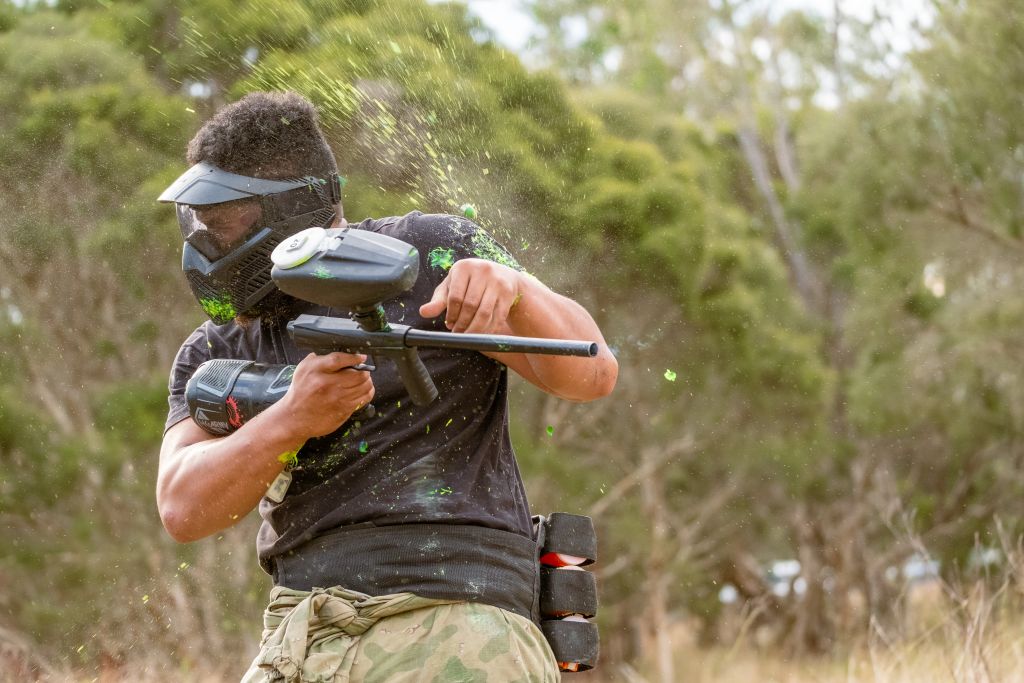
Does getting hit by a paintball sting? The short answer is yes, getting hit by a paintball can sting, very commonly described by players as feeling like being flicked by a rubber band. The impact varies depending on factors like distance and the type of paintball used, but most players describe it as a sharp, immediate, stinging sensation that usually fades quickly, often masked by the adrenaline of the game. While it’s not unbearable, it can leave a mark or a bruise.
Many players find that the adrenaline rush of the game helps to dull the pain. Once you’re in the heat of the action, the excitement often overshadows any discomfort from being hit. Plus, the thrill of dodging and shooting can make the experience more enjoyable, even if you do take a hit now and then.
Overall, while getting hit by a paintball does hurt to some extent, it’s usually manageable and part of the fun. With the right gear and mindset, most players find the experience to be exhilarating rather than painful. So, if you’re considering trying paintball, just be prepared for a little sting along the way!
Factors Affecting the Pain
- Distance: The closer the shooter, the more it hurts. A long-distance shot might only feel like a light “thump”.
- Clothing: Wearing loose fitting, long sleeve t-shirt and pants or renting a pair of overalls can reduce the impact compared to bare skin. Hits on bare skin (neck, hands) sting more, similar to a bee sting.
- Where you are hit: Fleshy areas (arms, legs) hurt less, while bony areas (back, head, knuckles) or sensitive areas (neck, inner thigh) sting more.
- Paintball Quality: Higher grade paint breaks easily and hurts less, while low grade paint is more likely to bounce and can sting more. That’s why Valhalla Paintball uses only the best paintballs.
What to Expect
- Intensity: Most first-timers are surprised by how little it hurts, comparing it to a mild, temporary sting.
- Aftermath: A hit might leave a small welt or a minor bruise that lasts a day or two, particularly if it was a close-range shot.
- Adrenaline: In the heat of the game, you may not even feel the impact immediately
A standard .68 caliber paintball typically hits with 10 to 13 Joules of energy at the muzzle.
Here is the breakdown of why this happens and how it varies:
- Standard Velocity: Most paintball fields enforce a velocity limit of 280–300 feet per second (FPS).
- Mass: A standard .68 caliber paintball weighs about 3 grams (0.003 kg).
- Calculation: Using the formula for kinetic energy (
), a 3-gram ball at 300 FPS results in approximately 12.5–13 Joule
A paintball traveling at 220 fps at 3 meters range will almost certainly hurt more than a 280 fps paintball at 30 meters.
While a higher velocity (280 fps) means more kinetic energy at the barrel, paintballs lose speed very quickly due to air resistance.
Here is the breakdown of why distance matters more than muzzle velocity in this scenario:
- 220 fps at 3 meters (Close Range): At 3 meters, the paintball has not lost much speed and has not experienced significant drag. It hits with a very high proportion of its initial energy, causing a sharp, stinging, and likely bruising impact.
- 280 fps at 30 meters (Medium/Long Range): Over a distance of 30 meters, a paintball loses a significant amount of velocity and kinetic energy. By the time it travels 40 meters, a 280 fps shot may be traveling much slower than the 220 fps shot at 3 meters.
Key Takeaway: In paintball, proximity is the primary factor in pain level. A lower velocity shot at close range (“bunkering”) is generally more painful and more likely to break skin than a high-velocity shot from across the field.